Sunday, 31 January 2010

Return of the links

For a while, every Friday I used to post a collection of links here - just fun stuff really, procrastinatory bits and pieces that might help pass the time on a boring Friday afternoon while waiting for the weekend. I think an especially busy few months put paid to that routine, though.

Later, posting a weekly round-up of interesting Twitter stories seemed like a good idea. It wasn't. It took only a couple of weeks to discover that reading numerous stories about Twitter every week, most of which you've in fact found on Twitter, very quickly starts to feel like voluntarily subjecting oneself to an especially noisy echo-chamber; i.e. not an entirely rational thing to commit to.

But ideally there would be at least one post on here each week, and finding something to write about on a weekly basis can be difficult. It's not that there aren't all kinds of things going on in the world of social media, the internet, technology, etc. - if anything, there's too much to keep track of. The real problem is finding an item that either hasn't already been covered by those big blogs that everyone already reads, or has been covered but to which I can still add a new angle (or at least an angle that I haven't already read somewhere else).

I suppose, I could just summarise whatever seems most important or interesting that week, but frankly that would just feel redundant - not a great motivation to write; or to read.

There's no reason, however, why I shouldn't do something more curatorial. So, the solution, revive the Friday links post, but in a slightly more structured and focussed form - and make it a Friday or Saturday post, to allow for any busy Fridays. There'll still be other posts too, of course.

One final reason to revive it: I don't know about anyone else, but I haven't been keeping up with The Guardian's Technology section now that it's no longer part of the print edition: what if part of this proposed Friday/Saturday links post were to be devoted to highlighting some of its more interesting or surprising stories each week? Problem solved.

As for what the rest of the links might be devoted to; well, I'm sure I'll have finalised the categories by Friday.

Or Saturday. But definitely one of the two.

Saturday, 30 January 2010

How to waste time. And influence people?

If anyone was wondering, it's actually surprisingly easy to find yourself responsible for wasting the time of hundreds of people you don't even know.

Or at least that's my excuse anyway.

Here's what happened.

It's early Thursday evening, I'm in a Tesco Express, as usual deeply dissatisfied with what's on offer. I've already wandered around the place at least three times without anything taking my fancy, and as a result am getting mildly exasperated with myself as well as at the store. 'Well,' I find myself snapping (not out loud), 'what actually do you want?' At which point, I can only assume that I object to the question's tone, because I start to sarcastically suggest crisp flavours, such as Salt & Vertigo, Cheese & Umbrage, or Soured Dreams & Chive. Ultimately, this proves quite diverting, I cheer up, and probably just buy some hummus or something. Who knows.

Anyway, a few more flavours come to mind on the way home, so I decide to tweet them, explained by the hashtag #rejectedcrispflavours.

And that's where the trouble starts.

A couple of people who follow my account, it turns out, are amused enough to suggest flavours themselves. One of them starts retweeting flavours suggested by some of his followers too. Soon enough, though, he's moved on to another game involving punnily combining soap operas with song titles, so I assume that's probably the end of that then, and get on with something else. Eating hummus, probably. Yet, unknown to me, it's not; it's not the end at all. The hashtag has begun to spread.

A couple of hours pass and it finally occurs to me to search Twitter for #rejectedcrispflavours. Not having expected it to be used by anyone else in the first place, and not even to the extent that it was, I'm curious to see how far it might have travelled during its brief moment. I'm certainly not expecting #rejectedcrispflavours to have turned into a Twitter meme...

Yet no, not only are there now hundreds of tweets appended with #rejectedcrispflavours, but people are still continuing to tweet new flavours!

Stomach-turning new flavours.

Frankly, for the most part, the whole thing's moved on a bit from my whimsical semi-puns: Godwin's law - "As an online discussion grows longer, the probability of a comparison involving Nazis or Hitler approaches 1" - should have an addendum in which the phrases "online discussion" and "comparison involving Nazis or Hitler" are replaced by "Twitter hashtag game" and "references to genitalia or bodily substances". Two hours later, and #rejectedcrispflavours, it seems, has turned into a Twitter gross-out contest.

While not exactly what I had in mind, to the extent that I had anything in mind, I can't say that it's not exciting to see it take on a life of its own.

I monitor for a little while longer, but am just about to leave it be, when I spot another tweet: someone is expressing bemusement that #rejectedcrispflavours is a UK trending topic! Surely not? J D Salinger's just died, Blair's due at the Chilcot inquiry tomorrow, the iPad was released just yesterday. And what do people in the UK want to tweet about? (Or, more accurately, try to disgust each other with?)

Yes. Crisps. (They are one of the few things the UK's good at, though, I suppose).

Over the next hour or two #rejectedcrispflavours, in fact, goes on to become the top UK trending topic: 'So this is what it's like to have power,' I think. 'And abuse it.' I feel proud, bemused, and ashamed, all at the same time. 'I've created a top UK trending topic! Wow...

'But it's this one. Sigh.'

So, yes, if anyone saw #rejectedcrispflavours in the UK trending topics, and wondered why, or perhaps despaired, well, this isn't so much me claiming credit as accepting the blame. Apparently this is the kind of thing that can happen if you have an argument with yourself in a supermarket. Be warned. (Or possibly encouraged, depending on your point of view).

Regardless of what the #rejectedcrispflavours hashtag eventually turned into, though, the whole thing was certainly a thoroughly fascinating first-hand lesson in exactly how easily something can (accidentally) go viral: all it took was having one follower* with the right kind of followers to propagate the idea (in this case, followers with a shared interest in hashtag games). That simple. Even knowing why marketers spend so much time and energy trying to identify and woo influential, connected voices online, I still couldn't help but be surprised. It really is, it seems, who you know.


*Of the two people who initially joined in; as far as I can tell, followers of only one of them went on to use the hashtag.

Tuesday, 26 January 2010

Panda Cloud - the hassle-free antivirus?


I think I may have already mentioned my opinion that the average antivirus program can be almost as annoying and intrusive as having an actual virus. The slow downs, the updating, the increased boot times, the panicky messages popping up for no good reason, all of them just add yet another layer of potential irritation to everyday computer use.

But, of course, an antivirus is a necessary evil, so at some point I settled on AVG as the least irritating of the bunch and resigned myself to trying to get along with it.

Then it started asking for money - to update the licence (I can only assume I unwittingly upgraded from the free version, though I have no idea when or how). I tried upgrading even further, to the latest version, 9.0 - the counter-intutive option so often seems to work with computer problems. No luck, of course - and on top of that, AVG, mystifyingly, now wanted to query every single action I made in Spotify, even after setting it as an exception.

So. Enough. Time for an antivirus option I've long been hoping wouldn't turn out to be too-good-to-be-true, Panda Cloud - recently out of beta, still free and, encouragingly, getting some excellent reviews.

Panda Cloud's aim is to be simple and hassle-free; analysing threats and updating itself in the cloud (hence the name), not taking over your entire system, using a minimum of bandwidth and system resources, and mostly just sitting there in your system tray keeping a sharp eye out for anything nasty. Moreover, because its virus signature database is in the cloud: a) it can be dowloaded and installed quickly; b) after installation, it doesn't have to do that initial update thing that can take forever; c) the database can be huge (currently terabyte-sized) - and can grow - without causing you storage problems; and d) it will always be up to date.

And how does it measure up in everyday use? Wonderfully.

Pros: Installation is extremely quick and easy, and on first scan it found and removed a trojan - an excellent start. It hasn't once slowed the system down, or queried a program or process it really ought to recognise; nor does the cloud itself seem to have suffered downtime. The interface is pleasingly simple and streamlined - possibly unnervingly so for control freaks and those used to the likes of Norton and McAfee - but does, however, reveal additional options as the need arises, such as letting you reinstate anything it may have neutralised.

Possible cons: according to the PCMag.com review, not the best option for cleaning up an already infected machine (stops malware getting on to the machine in the first place brilliantly, though: "the best free antivirus software available"); according to PC World, not the quickest at on-demand scanning (however, the review was pre- the full release, and even a full system scan was quick enough and unobtrusive enough for me).

Overall, then, exactly what I've always wanted from an antivirus: it does its job, it keeps to itself, and it's never the slightest bother. In fact, it's a shame Panda don't make housemates too.

Wednesday, 20 January 2010

In two minds about newspaper paywalls

Fabulous news, in 2011 The New York Times will start charging for its website! All we need now is for every other newspaper, magazine, the BBC and YouTube to join the Murdoch titles, the FT, Wall Street Journal, and so on, and we might all actually get some work done for once - instead of scrolling through Google Reader, opening links on Twitter, and searching in vain for stuff on iPlayer that we haven't already seen/heard once this week, before repeating it all again for no good reason other than it's been another twenty minutes.

Or maybe that's just me.

Anyway. Bliss. I almost can't wait.

(For one thing, I've always wondered what time travel might be like - this alone would be like going back five years).

But of course there's a much wider point here than a possible (but doubtless only temporary) boon to my personal productivity: mightn't widespread moves to paid and limited free content, effectively, ration news only to those who can afford it? And what of our present ability to compare sources and obtain a more rounded perspective on events? I mean, imagine a world where the current most popular news sources have even stronger voices - The Daily Mail? ITV? FOX News?

Brrrr...

Worse than 'Brrrr...'

But that assumes that most of us don't already rely, for the most part, on just one or two sources, usually supplemented only now and again when something especially interests or concerns us. Most of us do, I think. And most of the proposed paywalls will at least make a certain amount of articles free to non-regular readers, over certain time periods. (Even if such systems do, though, have the effect of penalising the site's most loyal readers).

The major concern, then, looks to be whether paywalls will be sufficiently open that there is enough news still freely available - to encourage diversity of opinions, democracy, free speech, or any of the other benefits suggested by commentators like Jeff Jarvis. Whether or not information really does want to be free, it would be terrible to lose any of these benefits, essentially, just for the sake of some adverts.

Sigh, and yet I really do quite like the idea of fewer distractions...

Well. You know. It's just such hard work using will power.

Thursday, 31 December 2009

Well, that's Christmas done, now for the Easter eggs

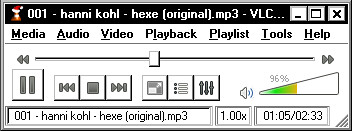
Shortly before Christmas, regular users of the VLC media player will have noticed that the program's little orange traffic cone icon sprouted a tiny Santa hat - indeed, it still has one.


The original image can be found here.

What I've found myself wondering since is, firstly, why exactly did this little touch make me smile so much, and, secondly, why don't more of the (non-entertainment) programs and web applications we use every day contain more of these kind of hidden surprises, or Easter eggs? I mean, let's face it, we need all the smiles we can get in life.

An initial answer to the first question, of course, is that it was an especially incongruous and unexpected addition - when a program's noted for being so stripped-back and basic in appearance, the sudden whimsical appearance of a Santa hat is about the last thing you'd expect. It can't help but be a pleasant surprise.

More than that, though, there's something genuinely cheering about happening upon a sudden little touch of warmth and humanity in the often sterile digital world of computers, about seeing that a program's creator genuinely has in mind those who use it, and about them being bothered to offer an otherwise totally pointless and unnecessary little something extra to raise a smile.

As for the second question; well, doesn't all this remind you of another organisation?

VLC might have its Santa hat, but Google is a company that gives out all manner of Easter eggs and surprises - from its logo doodles to its April Fool's pranks, to iGoogle wallpaper surprises, to all those bizarre autocomplete suggestions, and more besides. On one level, it could arguably get away without doing any of these things - they're not practical, integral parts of its services; they're mere fripperies. But on an another level, it's those very moments of unpredictability, playfulness and creativity that humanise the organisation, make it seem accessible, benign, exciting, and add to the sense of discovery. They build goodwill - and not just of a seasonal kind. If Google offer Easter eggs, and benefit from them, shouldn't other companies consider it?

By way of contrast, let's take Microsoft; which formally stopped including Easter eggs in its software in 2002.

If you read the Wikipedia entry, admittedly you can see, to an extent, the reasoning behind such a policy; but what the decision seems to mean in practice is that Microsoft programs no longer contain much that will (pleasantly) surprise, little that joyously rewards or positively encourages discovery and doing the unexpected, no real suggestions of humanity, humility, fallibility, play, exploration or openness - and if Google, or Apple, is far more strongly associated with discovery and creativity than Microsoft, if people see truth in those Mac vs. PC ads, and indeed if the Windows strapline "Where do you want to go today?" tends to ring hollow, maybe a lack of Easter eggs is at least a small part of the reason why?

The human touch, of course, extends even further with Google, into the somewhat quirky way it routinely chooses to release its products and services. Calling them betas or experimental Labs features, despite their often being perfectly useful and usable already, admits fallibility, suggests humility, invites input, gives Google valuable leeway to get things wrong without overly alienating its users. Microsoft, on the other hand, by taking its more formal approach, gives the impression of offering a finished article, so that any updates feel (perhaps misleadingly) less like improvements, more like tacit admissions that the original release was rushed and incomplete, flawed rather than evolving.

Adopting a more human touch and the inclusion of Easter eggs isn't without pitfalls, of course: if there's one thing humans are good at, it's disagreeing with other humans, and if there's another, it's being offended. Even VLC's Santa hat initially led to a complaint (later partially rescinded) - never mind that a Santa hat is hardly a religious symbol, or that it didn't even seem to be the commercialisation/secularisation of Christmas the user was at odds with!

On the upside, though, by being human and open, at least any offence, or actual misjudgements, can perhaps be more easily and reasonably addressed, should they occur - as above. And wouldn't a few people being offended be more than compensated for?

Whatever the case, though, there are surely plenty of companies, not just Microsoft, that might see their image benefit from a less staid approach; from every now and then doing tiny unexpected things to brighten our day; and generally, from seeing users of their products as fellow human beings, rather than captive consumers. Handing out Easter eggs at Christmas might seem an odd way of going about it, but it could be one of the easiest ways to start trying.

Monday, 28 December 2009

More than words?

When you earn your living from words it's always interesting to find new lights in which to view them - new ways of responding to words, putting them together, or even reading them - which is at least one reason why I've found myself, over the last week or two, digging into the world of independent video games (the other: it's Christmas; anyone who isn't feeling too lazy and bloated to do anything even remotely productive really hasn't got the hang of it) - and specifically, I mean the kind of independent games that, in one way or another, depend to a significant degree upon words.

Some of you (i.e. those that still remember such computers as the BBC Micro) will probably be thinking of text adventures right about now - or interactive fiction as the overall genre tends to be called now. We'll get to those a little later.

However, the games I've happened upon lately, and which I most want to highlight here, are more what might be termed 'art games', which is to say games created with the intention that playing them might evoke the same kind of effects and emotions that viewing a piece of art, or reading a poem, say, might evoke. To generalise even further: these are games that perhaps seek to move, more than to entertain. These are games like The Company of Myself.

On the surface, The Company of Myself is a simple platformer, but with the twist that in order to solve a puzzle and reach the green door to the next level you often have to co-operate with echoes of your own playing character - and on that level alone, it's an interestingly different way to while away some time. But reading the overall story of love and loss (and something altogether darker) that appears at the beginning and between levels - and which, you realise, you are playing out as you play those levels - is what gives it a strong and unexpected emotional hit, the strongest part of which is only clear once you have reached the end, heard the full story, and understood the implications of some of the actions that you've had to perform to progress. It's the quality of the writing as much as the game mechanics - and in combination with the game mechanics - that make this such a poignant experience. (A walkthrough can be found here, should you need it).

Another game that might be of interest to anyone with a professional interest in words is Today I Die, a sort of interactive poem of a game. A main character is controlled with the arrow keys, but at the same time in order to complete the game a poem must also be manipulated (changing its mood and meaning with each alteration to its words), with your character's final action also determining the final line and ultimate meaning of the poem. Again, it's a very satisfying example of interactive storytelling, and for me at least sparked off a new way of looking at words. (Again, hints are here, should you need them).

A rather more literal (and very literary) take on games that rely on words is Silent Conversation, by Gregory Weir, a platformer in which the landscape of each level is composed entirely from the text of a famous poem or short story, through and over which you must try to safely manoeuvre a letter 'I', even as you read the words themselves. In the background, sandstorms of the word 'sand' might fly past; or you'll find yourself leaping off the words 'ledge' or 'leap'; or the text will sometimes mirror its content, by forming a tunnel, for instance. Also, particularly poignant or affecting words are highlighted in red, the resonances of which you have to avoid and neutralise if you want to achieve the full score for each level.

How successful it is as a game may be open for debate - during longer levels things can get a bit repetitive, sometimes you'd rather just get on with the story, rather than going back or stopping to complete a particularly difficult section, you could find yourself wanting to argue whether some words really are the most powerful in any given text - but it definitely hints at what might be achieved, and at times it does genuinely seem to add something to your experience of reading the stories themselves (in fact, an involving new way of reading might ultimately be the best way to take the idea).

(Another wordy Gregory Weir title worth a look is The Majesty of Colours, by the way).

As for interactive fiction; I haven't investigated nearly enough yet to confidently recommend standout titles, but nonetheless the highly ambitious Blue Lacuna, especially, seems to go far, far beyond those frustrating Tolkien-esque things in which, as a kid, I always seemed to just blunder around getting hopelessly lost typing 'GO SOUTH', 'HELP' and 'WHERE AM I?' over and over again. Of the very few I have played, Aisle's been the most inspiring so far - essentially it's a very short story, with numerous potential endings, suggesting larger, more complicated stories, mostly reflective of the sanity or lack thereof of the actions you type.

As yet, I haven't enough experience of the genre to say exactly what I think there is to be learned from playing interactive fictions, but it's definitely a different way of writing - one that's very much about involving and immersing the reader - and one that excites me with its possibilities.

So here's an early New Year's resolution: to write an IF title myself. That should keep me busy...

N.B. For more IF game recommendations, the Interactive Fiction Database is a great place for short reviews and downloads. (Most interactive fictions come in story files, but an interpreter like Gargoyle will run most of them).

And on another note entirely...

A belated Merry Christmas and an early-ish Happy New Year from all at Radix!

Monday, 14 December 2009

Radix appoints new account manager

A press release we have issued today announcing that Matt Godfrey has joined the Radix team:

Penryn-based communications company Radix Communications has appointed a new account manager.

Matt Godfrey joins the company after a successful 15 year career in retail. Godfrey said, "Radix is a rapidly expanding business and is perfectly positioned for further success in a highly competitive industry. I am delighted to be given the opportunity to be part of that success."

Radix Communications provides copywriting, editing, design and translation services to a range of clients in the technology industry, placing a strong emphasis on clear, consistent and compelling written communications. Founded in 2007, it saw annual turnover grow by 14% in 2009 despite the economic downturn, and is on course to exceed this rate of growth in 2010.

"I am thrilled to welcome Matt to the team," said Radix managing director Fiona Campbell-Howes. "His management experience and exceptional commercial awareness will make him a tremendous asset to Radix as it continues to grow."

UPDATE: Here's the story on Business Cornwall - thanks Jay!